

School of Financial and Banking Technology strengthens corporate partnerships to enhance practical training
In the first half of 2026, the School of Financial and Banking Technology at the University of Finance – Marketing continued to strengthen partnerships with banks, securities firms, and financial institutions through professional practice programs for students.
This initiative reflects the Institute’s consistent commitment to connecting education with real-world practice while leveraging the role of enterprises in developing students’ professional competencies. Through collaboration between the University and its industry partners, students gain access to real-world work environments, explore professional operations, and gradually develop a professional mindset aligned with the demands of the finance, banking, and securities sectors.
Expanding the Partner Network in the Finance and Banking Sector
During the first semester of 2026, the School of Financial and Banking Technology collaborated with MB Bank, Nam A Bank, and Woori Bank Vietnam to implement the Professional Practice 1 program for Banking majors. At these institutions, students were introduced to organizational structures, products and services, operational processes, development strategies, and corporate culture. They also toured the workplaces and gained insights into the practical requirements of various job roles.
Building on this success, the partner network for the Professional Practice 2 program was further expanded in the second semester of 2026, both in terms of the number of partners and the diversity of sectors represented. The banking partners included various units of MB Bank, VIB, Vietcombank, Nam A Bank, VietinBank, and PGBank. In the securities sector, the program was supported by SSI Securities Corporation, Yuanta Securities Vietnam, and KIS Vietnam Securities Corporation.
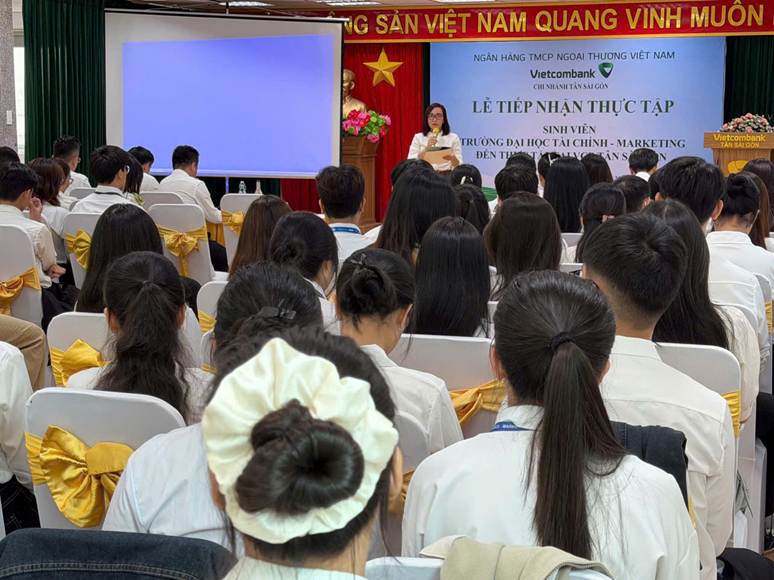
Students participating in the Professional Practice 2 program at Vietcombank Tan Sai Gon.
Expanding the partner network from commercial banks to securities firms has diversified the Institute’s corporate collaboration activities while aligning them more closely with the training scope of majors in the finance and banking field.
Corporate Partnerships in the Training Process
In these professional practice programs, enterprises serve not only as host organizations but also actively contribute to students’ learning by introducing their work environments, sharing practical knowledge, and guiding students in exploring professional operations.
Through the Professional Practice 1 program, students gain first-hand insights into the organizational structures, products and services, operational processes, and development strategies of participating banks. These experiences help students better understand the operations of financial institutions and the specific requirements of professional practice.
The Professional Practice 2 program provides a deeper level of practical engagement, allowing students to explore organizational structures, operational processes, products and services, and corporate culture in greater detail. Based on their observations and experiences at host organizations, students develop outlines and complete their professional practice reports under the guidance of both university lecturers and company staff.
This collaboration helps bridge the gap between academic knowledge and industry requirements. Through this process, enterprises help students move from “learning to know” to “learning to do,” while also providing valuable input for the University to update its training programs in line with real-world demands.
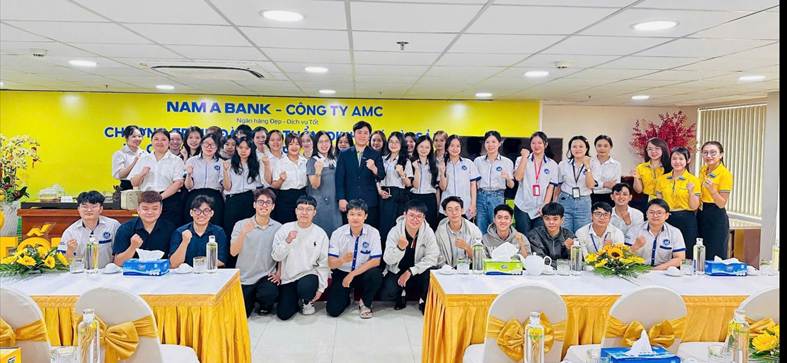
Students undertaking Professional Practice 1 at Nam A Commercial Joint Stock Bank.
A Partnership Delivering Mutual Value
For students, the programs provide opportunities to apply theoretical knowledge to real-world situations and develop skills in communication, teamwork, information gathering and processing, business analysis, and problem-solving. These practical experiences also help students gain a clearer understanding of professional requirements and make more informed career choices after graduation.
For the University, corporate partnerships reinforce its orientation toward applied education and help ensure that curricula remain closely aligned with labor market needs. The insights and practical experiences shared by partner organizations provide an important foundation for the Institute to further refine its training programs and strengthen students’ professional competencies.
For participating enterprises, involvement in the programs demonstrates their commitment to workforce development in the finance, banking, and securities sectors. Through introductory sessions, professional guidance, and the sharing of practical insights, enterprises help students develop a more accurate understanding of the workplace and the skills and competencies required by the industry.
Continuing to Strengthen University–Industry Ties
The Professional Practice 1 and Professional Practice 2 programs implemented in 2026 are tangible outcomes of the School of Financial and Banking Technology’s strengthened collaboration with financial institutions, banks, and securities firms.
Images of students participating in the programs at MB Bank, Nam A Bank, and Woori Bank Vietnam during the first semester, as well as at MB Transaction Center 2, MB Bank District 3, Vietcombank Tan Sai Gon Branch, and Nam A Bank Ngo Gia Tu during the second semester, demonstrate the active and practical engagement of partner organizations in welcoming, introducing, and guiding students.
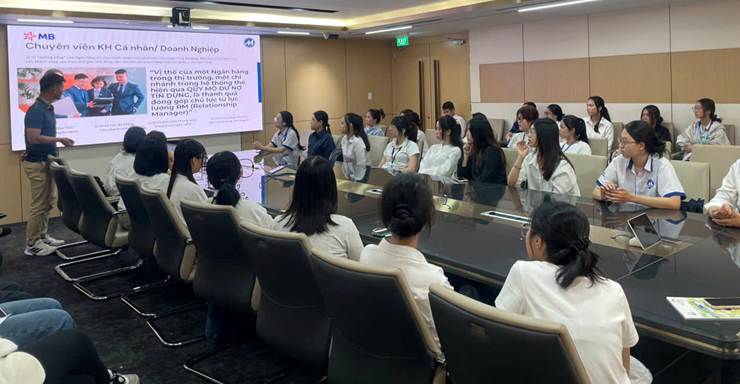
Students undertaking the second phase of professional training at MB Transaction Center 2.
The continued development and expansion of this corporate partnership network reaffirm the School of Financial and Banking Technology’s commitment to connecting education with practical applications. By prioritizing the development of students’ professional competencies, the Institute contributes to cultivating a highly skilled workforce capable of meeting industry demands in the context of digital transformation and international integration.
Nguyen Vu Than, Tran Nhan Nghia
School of Financial and Banking Technology.